Open
Research status: draft — abstracts on file in data/_raw/abstracts/; full-text quotes pending for the two 1997 papers (no abstract indexed). Lines marked pending or (W) are not yet backed by a primary source and are shown for review.
Two-sentence lead. Open rhinoplasty adds a transcolumellar incision to the endonasal incisions so the skin envelope can be lifted and the osseocartilaginous framework seen and grafted under direct vision; closed rhinoplasty works entirely through incisions inside the nostrils. The choice was the defining argument of late-20th-century rhinoplasty, argued in print by Jack Sheen (closed) and Jack Gunter (open) in the March 1997 Plastic and Reconstructive Surgery.
Technical definitions (surgeon-language body)
- Closed / endonasal. Access through intercartilaginous, intracartilaginous, marginal or transfixion incisions. No external scar. Tip work through delivery of the lower lateral cartilages or non-delivery (cartilage-splitting) approaches. Dorsal work by palpation and limited direct vision.
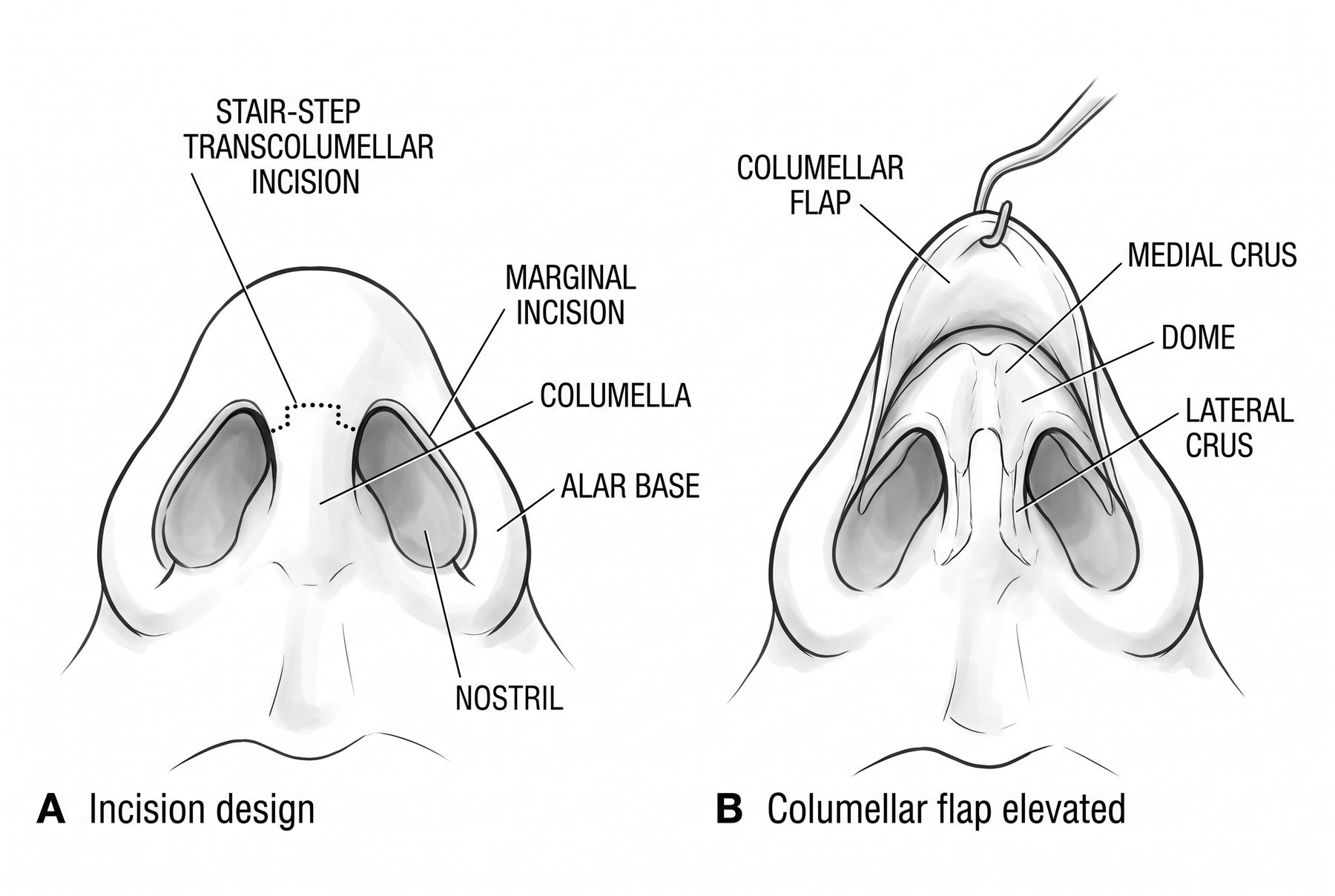
- Open / external. Marginal incisions joined by a transcolumellar incision (inverted-V or stair-step at the narrowest columellar point); the soft-tissue envelope is elevated in the sub-SMAS / supraperichondrial plane over the tip and dorsum. The lower lateral cartilages, septal angle, upper lateral cartilages and bony vault are seen in situ, undistorted. Grafts (spreader, columellar strut, tip, dorsal onlay, rib) are placed and sutured under direct vision. Cost: transcolumellar scar, longer tip edema, more dissection.
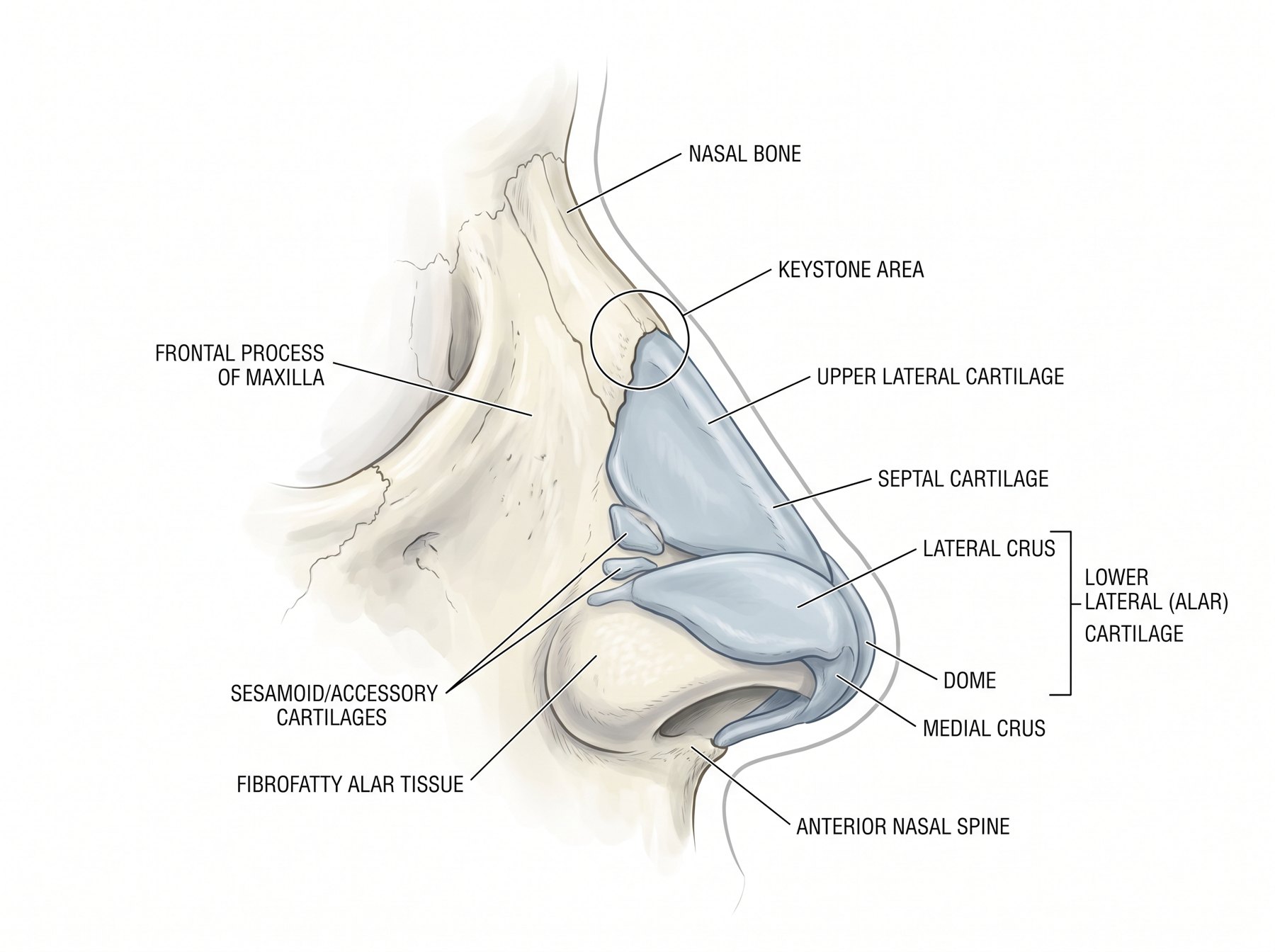
- Anatomy from the open perspective. "any surgeon who performs rhinoplastic procedures requires a sophisticated knowledge and understanding of the anatomy of the nose. This article reviews the anatomy of the nose from the perspective of the external rhinoplasty approach." (Goodman & Gilbert 1987, abstract)
The record
| Year | Event | Source |
|---|---|---|
| 1934 | Réthi describes the external approach (W) | Wikipedia |
| 1957 | Šerçer, "decortication of the nose" (W) | Wikipedia |
| 1970s | Padovan; then Goodman (Toronto) popularizes open rhinoplasty in otolaryngology (W) | Wikipedia; Goodman & Gilbert 1987 |
| 1984 | Gunter begins teaching the external approach to plastic surgeons at the first Dallas Rhinoplasty Course | Rohrich, PRS 2018 |
| 1987 | Gunter & Rohrich, "External approach for secondary rhinoplasty," PRS — "The first such article … a harbinger of things to come" | PMID 3602167; Rohrich 2018 |
| 1997 | Sheen, "Closed versus open rhinoplasty—and the debate goes on" (PRS 99:859) and Gunter, "The merits of the open approach in rhinoplasty" (PRS 99:863), printed back to back | PMIDs 9047208, 9047209 |
| 2010 | Cochran & Gunter: "This article discusses the steps involved in the external approach to secondary rhinoplasty." Septal cartilage is "the grafting material of choice"; auricular and rib cartilage in secondary cases | PMID 20206752 abstract |
| 2026 | Dallas meeting statement: "the widespread adoption of the open approach" | PR Newswire 2026 |
Indications as argued in the literature (to be quoted from full text)
- Open: secondary (revision) rhinoplasty with distorted anatomy; major grafting (rib); cleft and crooked nose; teaching. (Gunter 1987, 1997; Cochran & Gunter 2010)
- Closed: primary cases with limited tip work; preservation of tip support and skin vascularity; no scar; faster recovery. (Sheen 1997; Sheen, Aesthetic Rhinoplasty)
- Who does what today: The Rhinoplasty Society directory tags listings by procedure; both approaches remain in use; several Top-50 surgeons market "closed" specifically (e.g., Dugar's scarlessnose.com; Kanodia).
Gaps before the page ships
- Full-text quotations from Sheen 1997 and Gunter 1997 (PRS, paywalled).
- Primary citations for Réthi 1934 and Šerçer 1957.
- Outcome data: a systematic review comparing approaches (search PubMed: "open versus closed rhinoplasty" systematic review).