Preservation rhinoplasty and dorsal preservation
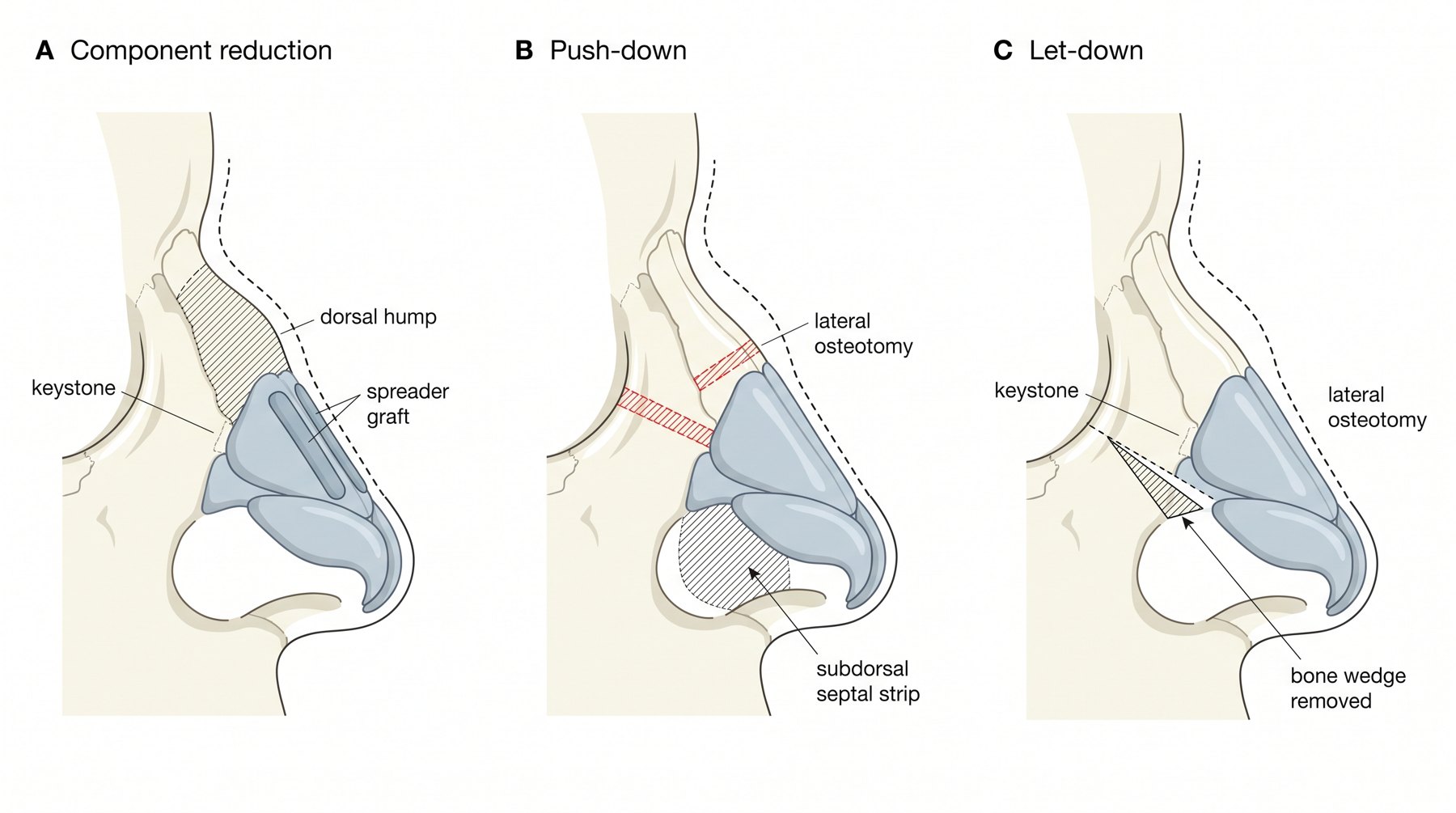
Two-sentence lead. Preservation rhinoplasty keeps the nasal dorsum, the ligaments and the alar cartilages intact and lowers a hump by mobilising the whole dorsum (push-down or let-down osteotomies with a septal strip), instead of resecting the hump and rebuilding the middle vault. The term dates from 2018 (Daniel) and the technique family from Saban's Nice series; by 2026 it is an "accepted philosophy" with its own textbooks, courses and a documented learning curve.
The record, in the authors' words
- 2018 — the name. Daniel RK, "The Preservation Rhinoplasty: A New Rhinoplasty Revolution," ASJ 38(2):228–229 (editorial; no abstract indexed). Daniel was Rhinoplasty Section Co-editor of ASJ.
- 2022 — open or closed. Kosins: "Preservation rhinoplasty (PR) is an evolving philosophy." Of 100 primary cases with ≥1-year follow-up (May–Nov 2020): "Fifty-six patients underwent an open approach and 44 a closed approach. Eighty-three patients had preservation of the dorsal soft tissue envelope… Sixty-seven patients underwent DP, with 38 receiving surface techniques and 29 undergoing impaction techniques. Thirty-three patients underwent structural rhinoplasty with piezoelectric osteotomies and mid-vault reconstruction… Four revision surgeries were necessary." Conclusion: "A closed PR is favored with thin skin, minimal dorsal modification, osseocartilaginous preservation (foundation techniques), less complex tip deformities, and overprojected noses. An open PR is favored for extensive dorsal modification, S-shaped nasal bones, complex tip deformities, and tip augmentation. Structural dorsal rhinoplasty is always conducted open and preferred for complex dorsal deformities and severe septal deviations."
- 2026 — the learning curve, 1,191 cases. Saban & Sachanandani (PRS, ahead of print): "We retrospectively reviewed 1,191 consecutive primary rhinoplasties performed by a single senior surgeon between 2010 and 2024… Series 1 (2010-2014; n = 320) introduced push-down and let-down osteotomies in selected cases. Series 2 (2015-2019; n = 352) expanded indications to more complex morphologies, exposing limitations. Series 3 (2020-2024; n = 519) applied a unified framework… Series 1 reported 11 revisions (3.4%)… Series 2 recorded 35 revisions (9.9%) during the uncontrolled expansion of indications. Series 3 demonstrated 17 revisions (3.3%)… (χ²(2) = 21.61, p < 0.001)… The evolution of DP rhinoplasty follows a U-shaped learning curve".
- 2026 — a decade on. Nissan & Kosins (ASJ 46(8):817–822): "Eight years have passed since the introduction of the term 'preservation rhinoplasty.' This approach has now gained worldwide popularity, and it is clear that preservation rhinoplasty has become an accepted philosophy due to its ability to produce stable, reliable, and beautiful results while minimizing the likelihood of secondary deformities that often arise from deconstruction-reconstruction (structural) rhinoplasty." Level of Evidence: 5.
Vocabulary the page defines (from the abstracts above)
- Dorsal preservation (DP) vs component reduction (the Rohrich 2004 technique) — the two ways down a hump.
- Surface techniques vs impaction / foundation techniques (push-down: the dorsum drops into the pyriform aperture after lateral osteotomies and a subdorsal septal strip; let-down: a wedge of bone is removed at the lateral osteotomy so the dorsum settles).
- Subdorsal septal strip methods (Barrera, commented by Saman & Saban, FPSAM 2026) — the septal modulator that lets the dorsum flatten; Saban's "pyramidal classification with named septoplasty modulators."
- Central keystone blocking point — the reason a hump recurs or won't flatten (Kovacevic 2026, "dorsal flattening with periosteal tensioning").
- Preservation of the dorsal soft-tissue envelope and ligaments (Pitanguy / scroll ligaments) — the second half of "preservation," independent of the bone work.
- Structural preservation rhinoplasty — the hybrid (Kosins, PRS 2022, PMID 35259146).
- Piezoelectric osteotomies — ultrasonic bone cutting used in the DP series (Kosins 2016, PMID 26545389).
Complications the page must list (from the sources)
Hump recurrence; residual radix hump / "saddle" from over-impaction; axis deviation; the 9.9% revision rate in an over-extended indication series (Saban series 2) vs 3.3–3.4% with selection.
Surgeons on the site who publish on this
Kosins (Top 50 #3; PRS Stal award 2024–26), Daniel (retired; named it), Saban (Nice — world list), Goksel (Istanbul — world list), Most (Top 50 #2; Dallas 2026 "preservation rhinoplasty overview" track), Rohrich (Dallas meeting chair; component reduction as the counterpart).
Gaps
- Pull the systematic reviews (PMIDs above) for pooled revision/complication rates.
- Daniel's editorial text (ASJ 2018) for the definition in his words.
- A diagram: push-down vs let-down vs component reduction on the same dorsum.