Rib
Research status: draft — Cochran/Gunter abstract verified; Toriumi titles pending. Lines marked pending or (W) are not yet backed by a primary source and are shown for review.
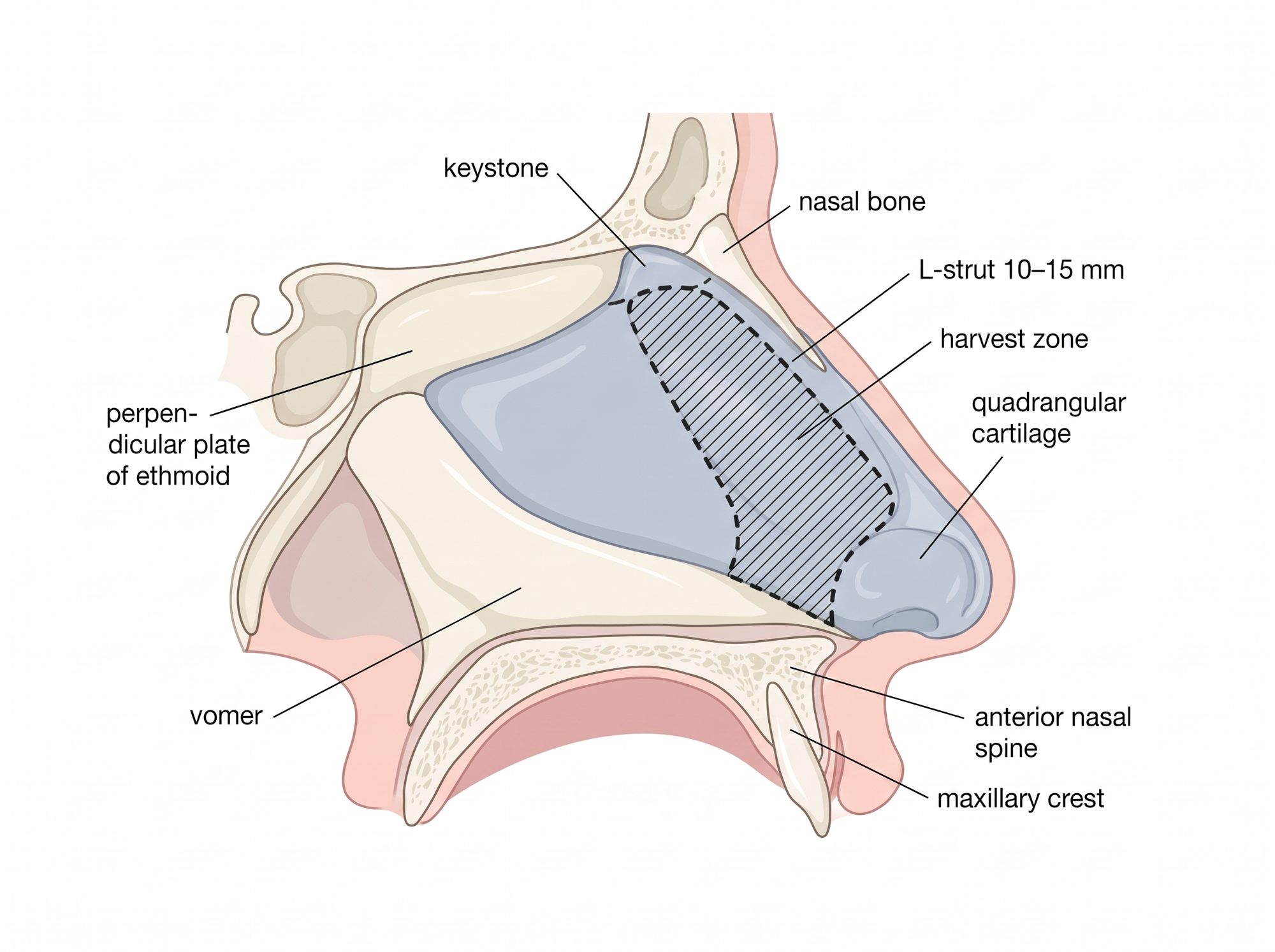
Two-sentence lead. When septal cartilage is gone, usually after a previous rhinoplasty, the surgeon harvests autogenous costal cartilage, most often from the 6th–8th rib, to rebuild the dorsum, the septal L-strut and the tip. It is the workhorse of secondary (revision) rhinoplasty and of the Dallas and Toriumi schools.
As published (abstract, verbatim)
"Postoperative rhinoplasty deformities—such as displacement or distortion of anatomic structures, inadequate surgery resulting in under-resection of the nasal framework, or over-resection caused by overzealous surgery—require a secondary rhinoplasty. Success in secondary rhinoplasty, therefore, relies on an accurate clinical diagnosis and analysis of the nasal deformities, a thorough operative plan to address each abnormality, and a meticulous surgical technique. Septal cartilage is the grafting material of choice for rhinoplasty; however, auricular cartilage and rib cartilage are used in secondary rhinoplasty. This article discusses the steps involved in the external approach to secondary rhinoplasty." — Cochran & Gunter, Clin Plast Surg 2010
What the page covers (surgeon-language sections, each to be sourced from a paper in the archive)
- Graft hierarchy. Septal → auricular (conchal) → costal; alloplasts (silicone, Medpor) and irradiated homologous rib as the alternatives and their failure modes.
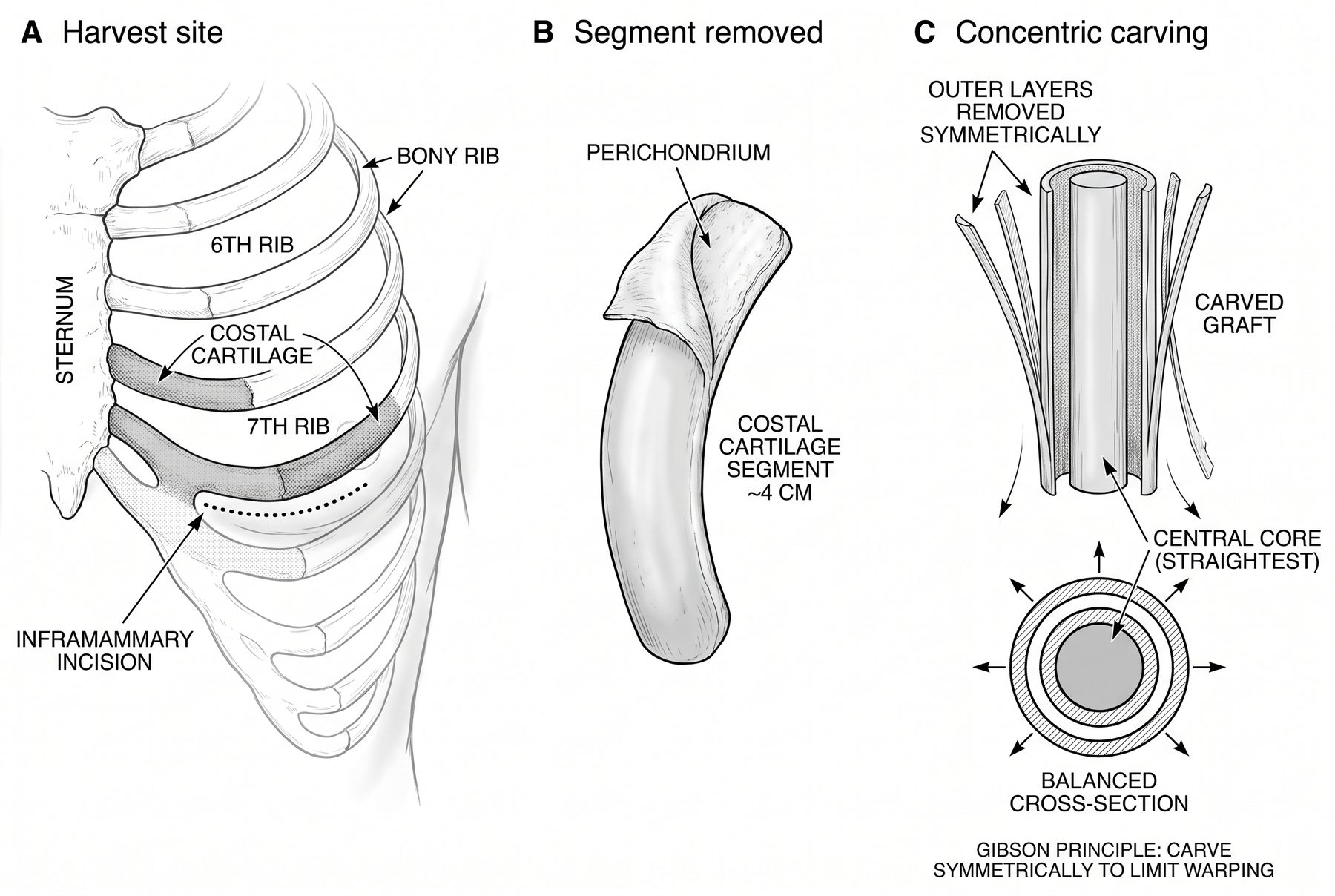
- Harvest. Inframammary / rib-margin incision; 6th–7th rib (or 8th–9th for a straight segment); perichondrium-sparing technique; pleural check (Valsalva under saline); donor-site pain and pneumothorax risk.
- Carving and warping. Concentric (balanced cross-section) carving; Gibson's principle; the 30–60-minute soak-and-observe; oblique-split and diced cartilage (DC-F: diced cartilage in fascia, Daniel) as warping-proof alternatives; K-wire / PDS-plate stabilized grafts.
- Uses. Dorsal onlay; caudal septal extension graft and septal L-strut reconstruction; extended spreader grafts; columellar strut; lateral crural strut; alar rim; tip grafts. Structure rhinoplasty (Toriumi) as the framework.
- Complications. Warping, resorption, visibility, infection, donor-site pneumothorax, chest scar.
Surgeons on the site who publish on this
Cochran (Dallas, Gunter Center; Top 50 #19), Gunter (history), Toriumi (Top 50 #7; costal cartilage series), Daniel (retired; DC-F), Kosins (Newport Beach; PRS 2026 Stal award, preservation + rib).
Gaps
- Pull the Toriumi costal-cartilage titles and abstracts (PMIDs above).
- Daniel's diced cartilage–fascia papers (PubMed: Daniel RK[au] AND diced cartilage).
- Warping rate data from a systematic review.